


What is the Maximum Print Speed of Materium?
There is no single maximum print speed for Materium. In pellet screw extrusion, print speed (mm/s) is determined by your printer’s capability of swinging around a 1.5kg extruder (Materium).
Then, what is the maximum volumetric output (flowrate)? It depends on material, temperature, and nozzle geometry. The dominant factor is nozzle size and type.
As a rule of thumb, every 0.2 mm reduction in nozzle diameter roughly halves maximum flowrate.
The included nozzle is a custom 0.4 mm M6 (Zenflow Nozzle). Materium supports standard M6 nozzles, and experimentation is encouraged.
Materium generates approximately 10–30 MPa of extrusion pressure, depending on material and temperature. From pressure, material, and nozzle diameter, flowrate can be estimated (e.g. via a flow model). The calculations are quite complicated as numbers vary greatly, but for examples :
Volumetric Flowrate Examples
| Material | Nozzle | Throughput |
| Polimaxx ABS | 0,4mm | 305g/h |
| Enviplast PLA | 0,4mm | 367g/h |
| Recycled PET Regrind | 0.4mm | 219g/h |
| Enviplast PLA | 0.8mm | 662g/h |
| Generic PP | 0.8mm | 600g/h |
Where do we source some pellets for tests?
Once you have a pellet extruder, your material options expand dramatically. Try searching on your online stores for:
- plastic pellets
- polymer resin
- regrind
- plastic granules, or anything with similar wordings
NOTE: In regions where PETG is not widely used industrially, what is often sold as “PETG” is actually PET mixed with glycerin. This is not PETG and will clog the extruder almost instantly, which is not a good way to start.
There are only two situations where the Metafuse team have ever jammed or clogged the Materium extruder:
- Using fake PETG
- Using recycled pellets contaminated with rocky debris
(explained here: https://www.youtube.com/watch?v=VS0k8SbBIIM)
With virgin pellets (meaning fresh unused raw material) the experience is very different and much smoother.
What is the purpose of toolboard? Is there any additional components like thermistor amplifiers?
Electronically, the toolboard itself is very simple. It contains a solid state relay, and everything else is just direct connections without any special logic.
If you choose not to use the toolboard, you can use an external SSR such as the Fotek SSR-40DA. This is commonly used in Voron builds and is easy to install. In that configuration, the toolboard mainly serves as a convenience layer. It uses JST connectors so the extruder components can plug into it directly, which makes maintenance easier. Without it, the outgoing cables for the fans, thermistor, probe, heater, motor, and so on must be extended yourself.
The thermal sensor is a PT1000, so there is no need for an amplifier. Modern control boards can read PT1000 sensors directly.
In practice, the Ender Toolboard is really a very specific simplification aimed at the Ender-3 V3 SE. For other printers without a specific toolboard, the Universal Toolboard is available as a variant.
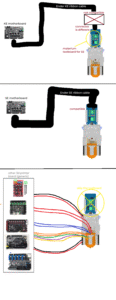
I have an Ender-3 V3 KE, does it work plug-and-play?
No, the Materium Ender variant is specific to the SE. Illustrated below:
What is the screw diameter? Why such low L/D ratio? Why is the spine so thick on one end?
The screw size and length are limited by how much space most desktop printers have. Materium was designed to fit existing printers, or require minimal headache for users to modify their machines.
Through testing, this is also the shortest length that still gives stable, usable print quality. Shorter screws don’t fully melt or stabilize the material, especially right after maintenance or material changes. “Stable, usable print quality” may differ greatly across use-cases or users. See what we meant by that in Metafuse Youtube channel, or Instagram.
Materium is designed to handle normal pellets, not tiny or specially prepared ones. The screw actually starts thinner at the feed and becomes thicker toward the end. That thicker section helps the material fully melt and even out before it exits the nozzle. Without this, prints become inconsistent.
What motor is being used?
Materium uses a NEMA17 bipolar stepper motor with a 50:1 planetary gearbox with an 8 mm output shaft. These are normally sold as ‘PG50 Stepper’.
If you plan to replace the motor, note:
-
The gearbox output shaft uses a keyed (crescent) shaft to prevent slipping under high torque, machined by Metafuse.
-
The gearbox can be separated from the motor, but the motor itself is a specific NEMA17 with small shafts with permanently attached gears, that are really hard to find separately.
- The motor mounting holes are for PG-style planetary gearboxes.
Should you choose to use your own motor, the required shaft geometry is documented in the Open Designs section of this wiki. See : Motor
Does Materium replace filament extruders?
Short answer: No.
Materium is not a replacement for filament extruders, and it is not intended to compete with them today. Filament-based 3D printing has evolved its own strengths that Materium does not currently aim to replicate, such as:
-
Very high print speeds
-
Multicolor and multimaterial workflows
-
Ultra-smooth surface finishes
-
Visually-oriented tools and slicers
Materium exists because other use cases were left behind as filament printing evolved. It is designed for:
-
Printing with industrial and non-standard polymers (See : Working With Polymer Feedstock)
-
High-commitment, functional parts
-
Very flexible materials
-
Research requiring material purity and spec transparency
-
Polymer formulation, compounding, and experimentation
-
Small-scale extrusion testing before larger machines
-
Teaching polymer processing in labs and industry
-
Small-batch filament production
Materium complements filament printers rather than replacing them.